Newport Beach to Laguna: The Coastal OC Window Tint Guide
Key Takeaway
Pacific Coast Highway between Newport Beach and Laguna Beach exposes drivers to direct overhead ultraviolet light, reflected light from the ocean surface, and marine salt aerosol that the California Coastal Commission documents traveling inland. NOAA publishes ultraviolet index forecasts and the National Weather Service Los Angeles and Oxnard office covers Orange County conditions. Ceramic window film blocks 99 percent of ultraviolet light, rejects a large share of infrared heat, and uses inert non-metallic particles that do not corrode in salt air.
Driving and parking between Newport Beach and Laguna Beach can involve bright reflections, long outdoor stops and changing light on the trip home. Those conditions make visibility and comfort useful priorities when comparing tint. Look at the exact film’s VLT, UV rejection and total solar-energy rejection rather than assuming dark glass blocks more heat. Interior film does not protect the vehicle’s exterior from salt air. Ask the installer about glazing compatibility, edge finish and written warranty coverage, then choose around your normal route and parking routine.
Coastal Light Is Not the Same as Inland Light
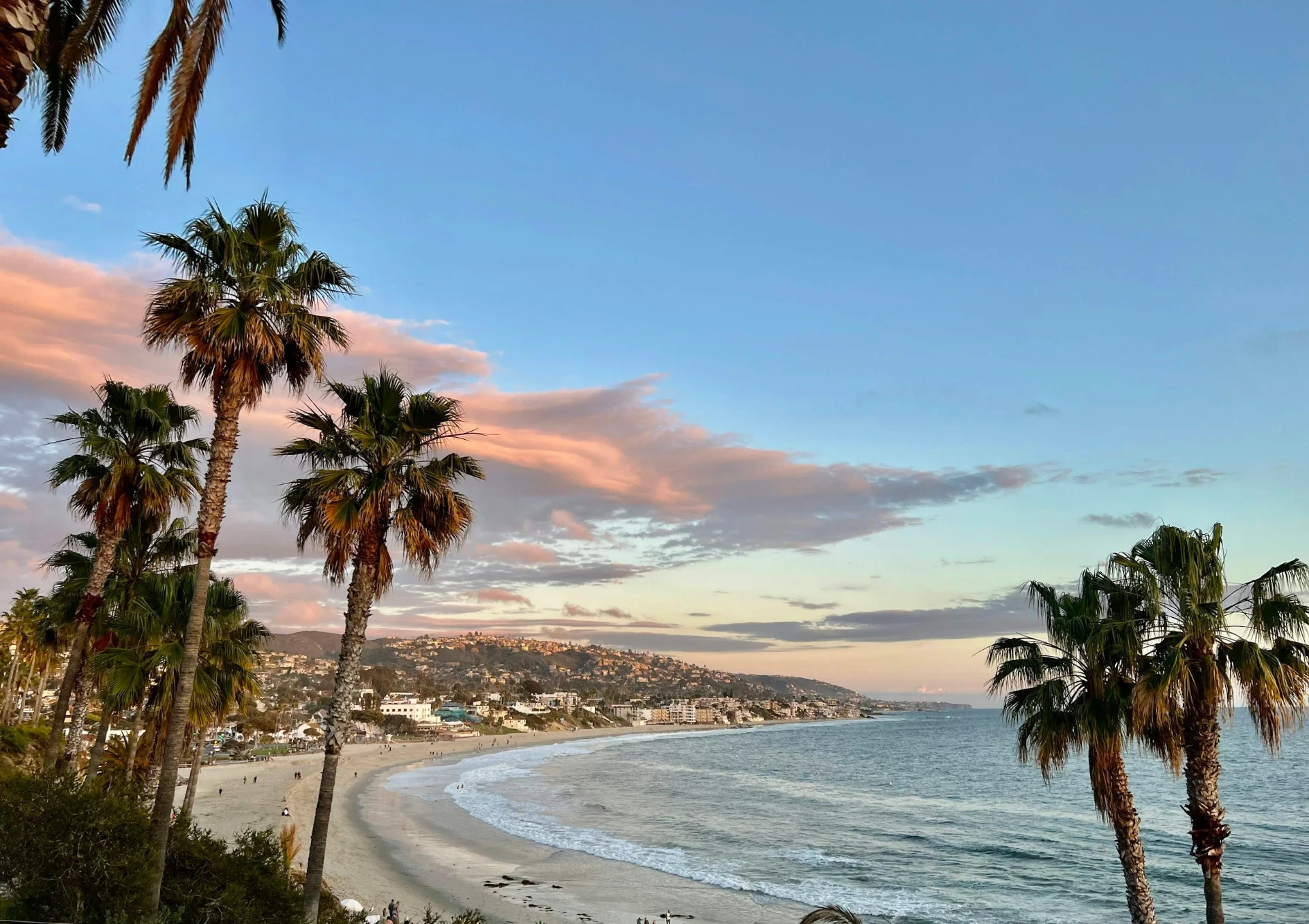
Ocean water reflects a meaningful fraction of incoming light back upward, so a coastal driver gets a direct dose and a reflected dose in the same moment. NOAA publishes daily UV Index forecasts, the EPA UV Index scale explains what those values mean, and Scripps Institution of Oceanography research quantifies reflectance from water surfaces. NWS Los Angeles/Oxnard covers Orange County forecasts and the marine layer patterns that dominate spring mornings.
The practical version: your left arm and the left side of your face take a disproportionate share of exposure on a southbound afternoon run, and untreated side glass blocks far less ultraviolet radiation than a laminated windshield does. Our UV and skin cancer guide covers the dermatology literature on that asymmetry.
Salt Air and Why Film Choice Matters
The California Coastal Commission documents marine aerosol carrying inland well past the shoreline, which is why coastal homeowners replace hardware faster and coastal cars show corrosion earlier. For window film, the relevant failure mode is edge corrosion in metallized products: moisture reaches the sputtered layer at a cut edge and the film hazes inward. Ceramic film has no metal layer to corrode, which is the single strongest argument for it in Newport, Laguna and Dana Point.
What We Install on the Coast
| Vehicle type | Recommended spec | Why |
|---|---|---|
| Daily commuter sedan | 70% ceramic windshield + fronts, 20–35% rears | Legal, clear at night, kills the PCH heat load |
| Convertible / roadster | 70% windshield, 70% fronts | Most exposure comes through the windshield top-down |
| EV with glass roof | Add roof film | Largest single heat load; reduces climate draw |
| Tow vehicle / marina truck | 70% front, 5–20% rears | Long dock-side parking in full sun |
Everything stays inside CVC §26708: 70% minimum on the front sides, any darkness allowed behind the driver, manufacturer label supplied.
Beach Parking, Realistically
Newport Beach and Laguna Beach both publish current parking rules and permit zones, and Visit Laguna Beach and Visit Newport Beach map the main lots. Almost all of it is uncovered. A surf session or a long lunch at Crystal Cove means several hours of unshaded exposure, which is exactly the scenario film is for.
Coastal Service, Mobile
We install at homes, offices and marina lots throughout coastal Orange County. Start with ceramic window tint or mobile installation, or check city pages for Newport Beach, Laguna Beach and Dana Point. Related: PCH marine layer glare and coastal luxury vehicle tint.
Frequently Asked Questions
Is salt air actually a problem for window film?
It is a problem for the wrong film. Metallized films rely on a thin sputtered metal layer that can corrode where moisture reaches an edge, which shows as a cloudy haze creeping in from the perimeter. Ceramic films use inert non-metallic particles and are unaffected by chloride-laden coastal air.
Why does PCH feel brighter than an inland drive?
You are getting light twice: direct sun overhead and reflected light off the water surface. Add the low sun angle in the late afternoon heading south and it becomes a genuine visibility problem, not just discomfort.
What tint works best for a convertible or a car with a glass roof?
Prioritise the windshield and any fixed glass roof, since those take the largest share of the load. A 70% ceramic IR windshield plus roof film changes the feel of an open-top car dramatically without darkening the cabin.
Which Orange County cities do you cover?
All of them, including Newport Beach, Laguna Beach, Laguna Niguel, Dana Point, Costa Mesa, Huntington Beach, Irvine, Anaheim and San Clemente. We install at homes, offices and marina lots.
Will tint stop marine layer glare in the morning?
Partly. Marine layer glare is diffuse light scattered by moisture, and film reduces its intensity but no film eliminates it. A quality 70% ceramic windshield with high optical clarity helps noticeably, while cheap film with poor clarity makes diffuse glare worse.
Related Window Tint Guides
More from our auto window tint research library — each guide covers a different part of the same topic.
- marine grade window tint orange countyNewport Beach & Dana Point Yacht Owners: Why Your Tow Vehicle Needs Marine-Grade Ceramic Tint Too
- anaheim car parking heat protectionDisneyland Parking Heat: A Magic Key Holder's Guide to Protecting the Car
- event parking car heat orange countyOC Event Parking Heat: Angel Stadium, Honda Center and the OC Fair
- window tinting huntington beachSurf City USA: Why Huntington Beach Surfers Need UV + Salt-Resistant Tint
- window tinting laguna beachLaguna Beach & Dana Point: PCH Glare, Coastal Salt, and Luxury Ceramic Tint
- windshield tint orange countyOrange County PCH Marine-Layer Glare: Why You Need a 70% Ceramic Windshield Strip
What Our Customers Say
Get Your Free Tint Quote in 60 Seconds
Premium mobile window tinting across San Diego & Orange County. We come to your home, office, or anywhere convenient — same-week appointments available.
GET YOUR FREE QUOTE
Service Type *
Add-ons (optional)