Solar Radiation Explained: UV, Visible Light & Infrared — What Window Tint Actually Blocks
Key Takeaway
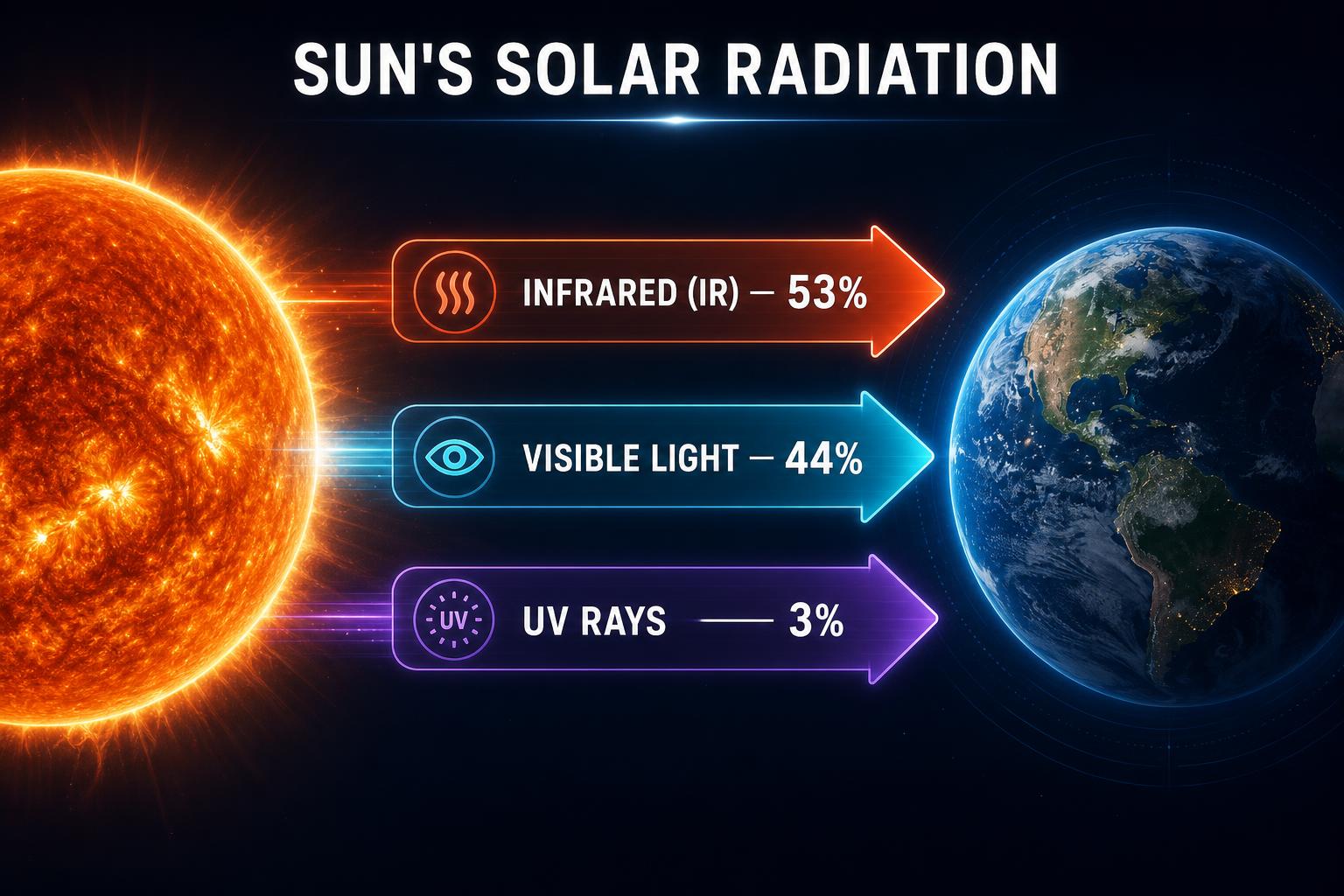
Solar radiation reaching Earth is composed of three wavelength bands: ultraviolet (UV) at 3–5%, visible light at 42–44%, and infrared (IR) at 52–55%. Premium ceramic window film, such as the films installed by BestAutoTechs in San Diego and Orange County, blocks up to 99% of UV and 97% of infrared while preserving optical clarity. This combination is the most effective passive solar control available for vehicles, homes, and commercial buildings.
Sunlight contains ultraviolet, visible and infrared energy, and window film changes transmission across those bands in different ways. Do not read a visible-light percentage as a complete measure of heat rejection, or an infrared meter result as the total solar-energy performance of the finished glass. Compare the manufacturer’s current specification sheet, including the test conditions and total solar-energy rejection. Those details are more useful than a single spectrum percentage when deciding whether two films at the same shade will feel different in your vehicle.
This guide breaks down the science with citations from NASA, the EPA, the World Health Organization, the International Window Film Association (IWFA), and the Skin Cancer Foundation — then translates it into what actually matters when you're driving the I-5 in July.
The Three Components of Solar Radiation
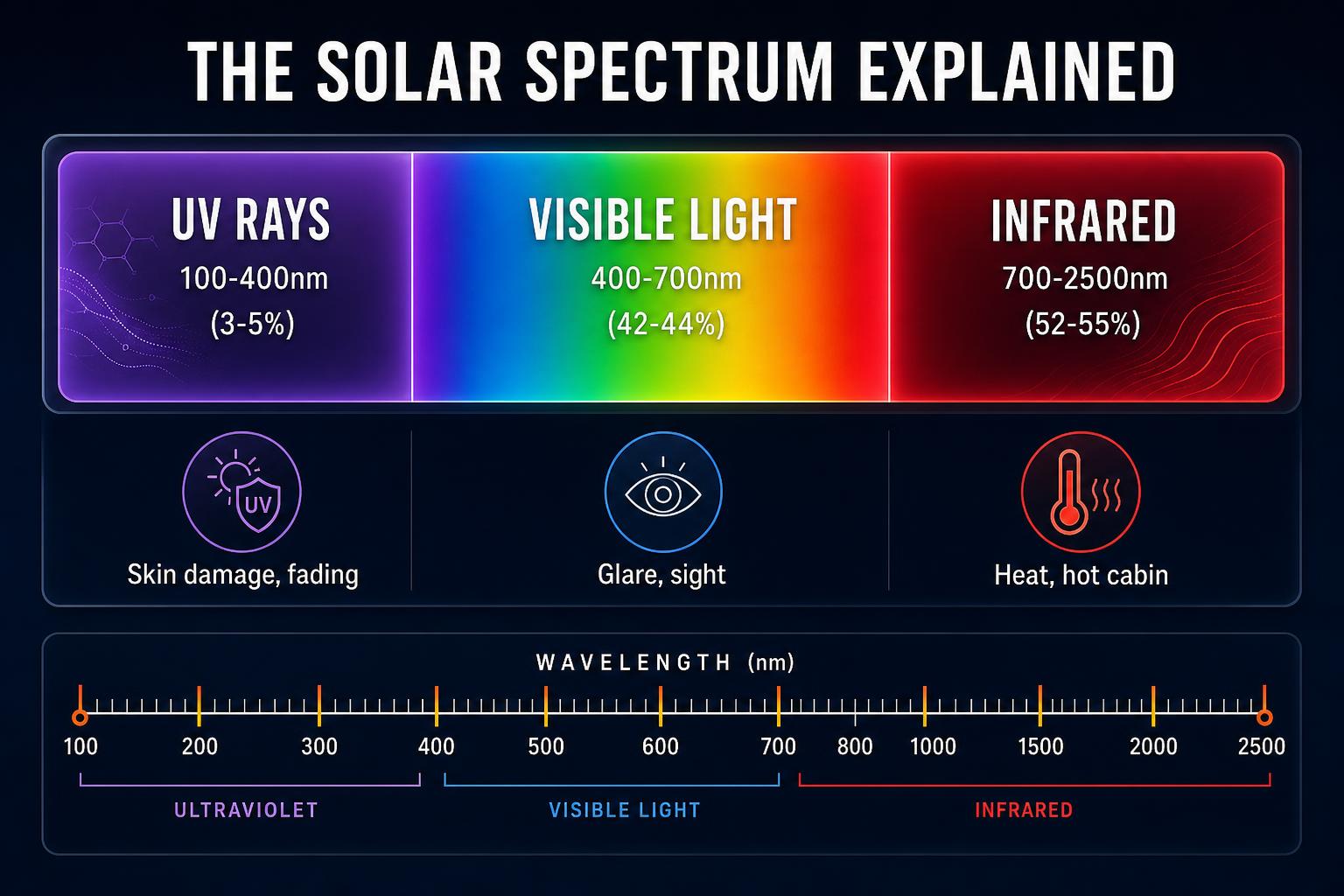
According to NASA's Earth Observatory Energy Budget and NREL's reference solar spectrum (ASTM G-173), the sun's radiation at sea level breaks down as follows:
1. Ultraviolet (UV) — 3–5% of solar energy
Tiny in percentage, enormous in damage. UV is split into UVA (315–400 nm, about 95% of UV reaching ground), UVB (280–315 nm, about 5%), and UVC (fully absorbed by the ozone layer). The World Health Organization and the Skin Cancer Foundation identify UV as the primary cause of skin cancer, premature aging, cataracts, and interior fading.
Critical for drivers: standard automotive side glass blocks UVB but transmits up to 70% of UVA, per research published in JAMA Ophthalmology. That's why dermatologists at UC San Diego Health Dermatology and Hoag Skin Cancer Program (Newport Beach) routinely recommend UV-blocking window film for daily drivers.
2. Visible Light — 42–44% of solar energy
Wavelengths between 400–700 nm — what your eyes actually see. Visible light isn't dangerous, but it causes glare, eye fatigue, and contributes to fading of dashboards and upholstery. The metric here is VLT (Visible Light Transmittance): a 35% VLT film lets 35% of visible light through.
California Vehicle Code §26708 dictates legal VLT for front side windows (70%+ when combined with factory glass). See our full San Diego tint laws guide for compliance details.
3. Infrared (IR) — 52–55% of solar energy
The big one. IR (700–2500 nm) is what you feel as heat. It's the reason a black dashboard hits 180°F on a 95°F day in Poway. NHTSA heatstroke data shows cabin temperatures can climb 40°F+ above ambient within an hour.
IR is the wavelength range where premium ceramic and carbon IR films dramatically outperform basic dyed films. Modern nano-ceramic technology selectively rejects IR while preserving visible clarity — which is the entire reason ceramic costs more.
How Ceramic Tint Blocks Each Wavelength
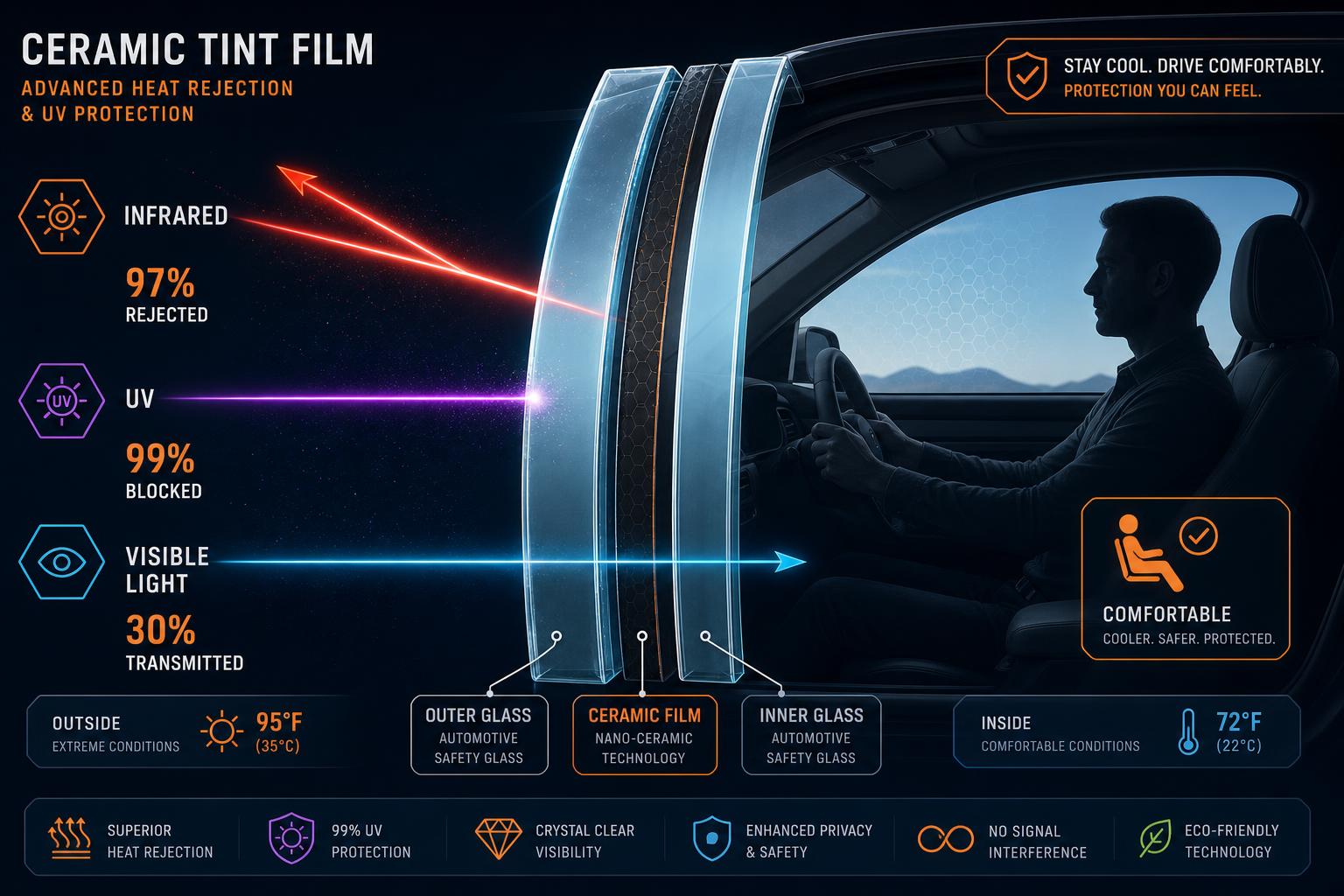
Premium ceramic film uses non-metallic, non-conductive ceramic nanoparticles embedded in the polyester layer. According to the International Window Film Association (IWFA), properly engineered ceramic films deliver:
- 99% UV rejection — meeting Skin Cancer Foundation Seal of Recommendation criteria
- Up to 97% IR rejection on top-tier ceramic IR films
- 50–65% TSER (Total Solar Energy Rejection) depending on shade
- No signal interference — unlike older metallized films that block GPS, Bluetooth, and cellular
Film Comparison: Ceramic IR vs Carbon IR vs Dyed
| Performance Metric | Dyed Film | Carbon IR | Ceramic IR |
|---|---|---|---|
| UV Rejection | ~40% | 99% | 99% |
| IR Rejection | 5–10% | 35–75% | 70–97% |
| TSER (35% shade) | ~25% | ~41% | ~50% |
| Signal Friendly | Yes | Yes | Yes |
| Lifespan | 3–5 yrs | 10+ yrs | Lifetime |
Try our interactive HiTek Ceramic IR vs Carbon IR comparison tool or read the deep-dive Ceramic IR vs Carbon IR breakdown.
Our Film Partner: HiTek Films
BestAutoTechs is a certified installer of HiTek Films — a premium American window film manufacturer specializing in ceramic IR and carbon IR technology. HiTek's lab-tested specs include up to 75% IRR and 65% TSER, with a manufacturer-backed lifetime warranty. Explore the full HiTek Ceramic IR product page for technical data sheets.
Why Solar Radiation Hits Harder in San Diego & Orange County
Southern California compounds every solar-radiation problem:
- UV Index 9–11 common from May–September per the EPA UV Index and NWS San Diego.
- Coastal UV reflection adds 10–25% extra exposure for La Jolla, Coronado, Newport, and Laguna drivers, per Scripps Institution of Oceanography research.
- 280+ sunny days/year across San Diego and Orange County (NOAA NCEI climate data).
- Inland heat amplification in Escondido, El Cajon, Temecula, and Anaheim regularly pushes summer highs past 100°F — see our cabin temperature data analysis.
Local Authority Resources
For verified sun-safety and skin-health guidance from trusted San Diego and Orange County institutions:
- UC San Diego Moores Cancer Center — Skin Cancer Program
- Hoag Hospital — Skin Cancer Center (Newport Beach)
- San Diego County Health & Human Services
- OC Health Care Agency
- SDG&E Energy Efficiency Center — heat-rejection benefits for home film
- Scripps Institution of Oceanography (UCSD)
Our Trusted Network Partners
When our mobile schedule fills up or a customer is outside our daily route, we refer to a small group of vetted Southern California tint operators who install to the same standard:
- Best Auto Tinting — HiTek Ceramic specialists, Southern California coverage.
- Best Auto Tint — Premium ceramic and carbon installs.
- San Diego Window Tint — Established San Diego County tint shop.
- SoCal Window Tinters — Orange County and Inland Empire coverage.
Learn more about BestAutoTechs and our partner network.
The Bottom Line
Solar radiation isn't one thing — it's three. Understanding the 3/44/53 split between UV, visible light, and infrared is the difference between buying tint that just looks dark and buying tint that actually protects your skin, your interior, and your comfort. For Southern California drivers, ceramic IR is the only film engineered to handle all three wavelength bands at once.
Ready to upgrade? Check our ceramic tint service page, browse carbon film options, or use the tint shade selector to preview shades on your vehicle before you book.
Frequently Asked Questions
What percentage of solar radiation is heat?
Roughly 52–55% of the solar energy reaching Earth's surface is infrared (IR) radiation — the wavelengths you feel as heat. According to NASA's Earth Observatory and NOAA solar spectrum data, infrared dominates the total energy budget even though visible light is what we see.
How much of sunlight is UV?
Only about 3–5% of solar radiation at the surface is ultraviolet, but the EPA, WHO, and Skin Cancer Foundation all confirm that this small slice causes nearly all sun-related skin damage, including premature aging and skin cancer. UVA (95% of UV) penetrates standard car glass — UVB (5%) mostly does not.
Does window tint actually block heat?
Yes — but only quality ceramic or carbon IR films. The International Window Film Association (IWFA) confirms premium ceramic films reject up to 97% of infrared and 99% of UV. Cheap dyed films primarily darken visible light and offer minimal heat or UV rejection.
Does standard car glass block UV?
Partially. Laminated windshields block most UVB and a significant share of UVA. Side and rear tempered windows block UVB but allow up to 70% of UVA through, according to JAMA Ophthalmology and CDC research. That's why dermatologists recommend UV-blocking film for daily drivers.
Why does San Diego need stronger IR rejection than other cities?
Southern California's combination of high UV index (often 9–11 in summer per the EPA UV Index), coastal reflection from the Pacific (NOAA/Scripps data), and 280+ sunny days per year (NWS San Diego) means cabin temperatures climb faster than in most U.S. markets. Ceramic IR film is the most effective passive defense.
What's the difference between TSER and IRR?
TSER (Total Solar Energy Rejection) measures how much total solar energy — UV + visible + IR combined — is blocked. IRR (Infrared Rejection) measures only the heat-causing infrared portion. A film can have high IRR but moderate TSER. Both numbers matter when comparing films like HiTek Ceramic IR vs Carbon IR.
Related Window Tint Guides
More from our ceramic window tint research library — each guide covers a different part of the same topic.
- ceramic vs carbon window tint San DiegoCeramic vs Carbon Window Tint San Diego: Worth It?
- factory tinted windows vs aftermarket2026 LA & San Diego Auto Show: What New OEM Factory Tint Trends Mean for California Drivers
- ceramic ir vs carbon ir tintHiTek Ceramic IR vs Carbon IR Window Tint: Complete Comparison Guide
- factory tintFactory Tint Isn't Window Tint: What Your Privacy Glass Really Does (and Doesn't)
- windshield brow tintWindshield Brow + Full Ceramic Tint: The Toyota Prius La Mesa Heat-Rejection Package
- best window tint for san diegoBest Window Tint for San Diego's Coastal Climate: Salt Air, Sun & Marine Layer
What Our Customers Say
Get Your Free Tint Quote in 60 Seconds
Premium mobile window tinting across San Diego & Orange County. We come to your home, office, or anywhere convenient — same-week appointments available.
GET YOUR FREE QUOTE
Service Type *
Add-ons (optional)